




.jpg?width=40&height=40&name=Untitled%20design%20(2).jpg)
Forecasting Isn’t a Guessing Game Anymore
For decades, many energy suppliers have relied on a mix of experience, instinct, and spreadsheets to guide forecasting decisions. That approach might have worked when markets were more predictable, but that is no longer the case.
Extreme weather events, rapid policy changes, renewable integration, and AI-driven demand growth have made volatility a permanent feature, not a temporary cycle. In this environment, forecasting isn’t about “getting close enough.” It’s about protecting your margins, staying competitive, and keeping compliance headaches at bay.
Gut feel and spreadsheets can’t keep pace. The cost of sticking with them isn’t just small errors, but cascading losses that eat away at your business.
The Problem With Gut Feel Forecasting
Forecasting based on gut feel, instinct, or historical patterns alone is increasingly risky. It’s like trying to navigate a storm with yesterday’s weather map. You might get lucky, but you’re just as likely to end up miles off course.
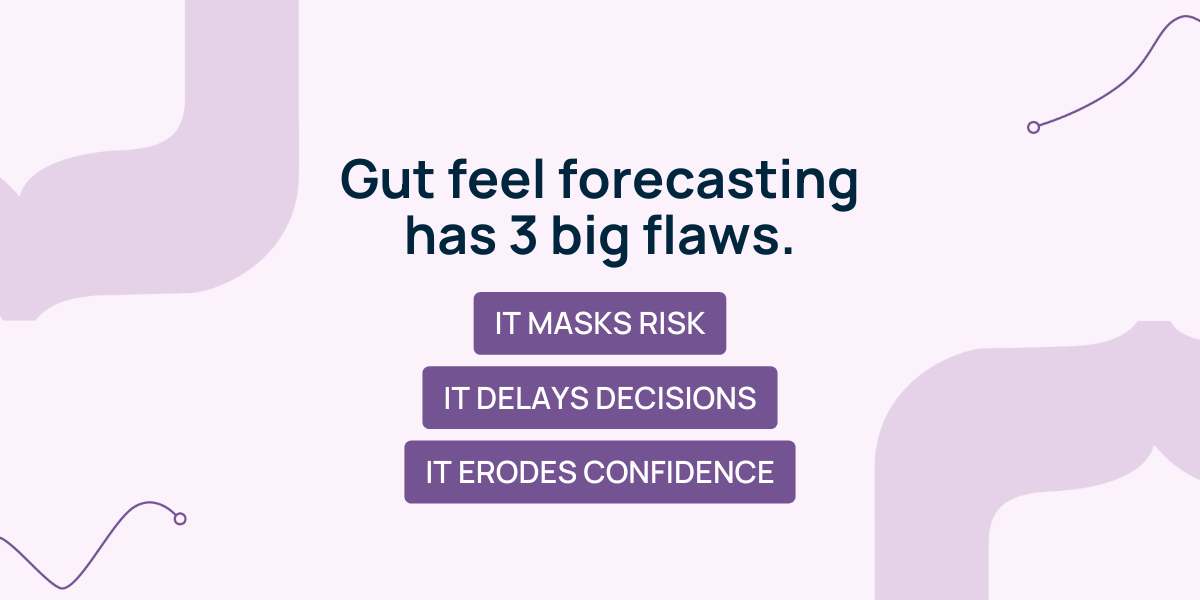
Gut feel forecasting has three big flaws:
- It masks risk. You may think your numbers are stable, but single-point assumptions hide the range of possible outcomes.
- It delays decisions. Without clear visibility into uncertainty, teams hesitate or argue over next steps.
- It erodes confidence. Executives, customers, and regulators quickly lose trust when actual results consistently miss the mark.
Take winter demand as an example. If your instinct tells you demand will be “about average,” but a cold snap drives usage 7% higher, you’re left scrambling. The result? Overbuying energy to cover the gap, locking in at higher prices, and stranding costs that could have been avoided.
Gut feel is gambling.
Why Spreadsheets Are Holding Suppliers Back
Many suppliers recognize that instinct alone isn’t enough, so they turn to spreadsheets as a step up. But spreadsheets come with their own limitations that quietly drag down performance.
Common spreadsheet problems include:
- Siloed data: Inputs live in disconnected files or departments, making it difficult to align on “the truth.”
- Stale inputs: Data feeds aren’t refreshed in real time, so teams end up working with outdated assumptions.
- Version-control chaos: Multiple versions of the same forecast circulate, creating confusion and wasted time.
- No stress-testing: Spreadsheets typically provide a single forecast line, with no structured way to model volatility or worst-case scenarios.
When forecasting errors occur, these issues create a ripple effect:
- Procurement missteps lead to stranded energy and unnecessary costs.
- Pricing mismatches make customer offers uncompetitive.
- Compliance headaches arise when reporting doesn’t align with actuals.
Spreadsheets may feel safe and familiar, but in today’s market, they’re quietly sabotaging profitability.

Case in Point: Supplier A vs. Supplier B
The difference between legacy tools and modern models is best illustrated with a real-world style comparison.
Supplier A (Spreadsheet-Based Forecasting)
- Missed winter demand by 7%
- Overbought 15% of energy, leading to stranded cost
- Couldn’t adjust procurement dynamically
- Customer prices ended up uncompetitive
- Margin impact: –$800,000
Supplier B (Probabilistic Modeling Approach)
- Stayed within 2% of actual demand (inside modeled variance band)
- Adjusted procurement dynamically as conditions shifted
- Tiered pricing remained competitive in the market
- Margin impact: +$300,000
Bad forecasts don’t just mislead. They multiply loss. Every misplaced assumption compounds downstream, turning small errors into major financial hits. On the flip side, accurate and adaptive forecasting avoids losses and actively creates margin protection.
.png?width=1200&height=600&name=Blog_Risk360LeadMagnet%232_1200x600%20(1).png)
Why It Matters for Energy Suppliers
These aren’t just abstract risks. Inaccurate forecasting shows up in the day-to-day operations of your business in ways that directly impact performance:
- Stranded Costs: Overbuying energy leaves you holding positions you can’t monetize, tying up capital and squeezing margins.
- Uncompetitive Pricing: Forecast misses make your offers less attractive to customers, opening the door for competitors.
- Customer Churn: Customers notice when pricing seems out of step with the market, and they’re quicker than ever to switch suppliers.
- Compliance Risk: Regulators expect transparency and accuracy. Poor forecasting can complicate reporting and attract scrutiny.
- Executive Uncertainty: Leadership loses confidence in the numbers, leading to slower decision-making and organizational friction.
For suppliers already operating in a high-stakes environment, each of these risks compounds the pressure to forecast smarter.
Moving Beyond Guesswork
What’s the alternative? The answer is probabilistic forecasting, a method that models a range of possible outcomes instead of betting everything on a single point.
A modern probabilistic approach includes:
- Confidence bands (P50, P75, P95) that make uncertainty visible, not hidden.
- Scenario testing that runs price spikes, demand surges, or regulatory changes as part of regular planning.
- Dynamic adjustments that adapt procurement and pricing decisions in real time.
- Actionable outputs that don’t just show charts but clearly define “If X happens, we do Y.”
This isn’t about adding complexity for its own sake. It’s about replacing blind spots with clarity and giving your teams the tools to make confident, margin-protecting decisions even when markets shift suddenly.
Strategic Takeaways for Energy Suppliers
If you’re still relying on gut feel or spreadsheets, it’s time to take a hard look at how much that’s really costing you. Consider these steps:
- Audit your current forecasting tools and identify where manual processes or stale data create delays.
- Compare your forecast misses to actual outcomes over the past year—how much margin was lost due to inaccuracies?
- Introduce confidence bands into your next forecast to help leadership see the range of possible outcomes.
- Begin stress-testing your models with scenarios like demand spikes, regulatory shifts, or data failures.
Small changes in how you approach forecasting can create significant margin protection and unlock new confidence across your organization.
Replace Forecasting Guesswork with Clarity
Suppliers who cling to gut feel and spreadsheets are leaving profitability on the table while competitors move ahead with smarter, more resilient forecasting approaches.
But this is just one way legacy forecasting falls short. For a deeper dive into practical strategies and step-by-step moves to modernize your forecasting, download our brand new guide The New Era of Risk: Smarter Forecasting for Energy Suppliers.
It’s time to stop gambling with your margins and start building confidence into every decision.

Share this

Have an Energy Supplier Shortage? 3 Ways to Get More Energy Suppliers

Revolutionize Your Energy Pricing Strategies and Drive Business Growth