




.jpg?width=40&height=40&name=Untitled%20design%20(2).jpg)
Understanding the Latest Energy Market Trends
Geo-political instability, bad weather and rising costs. Q1 2026 was a tough quarter for UK businesses managing their energy spend, and the latest data makes that very clear.
Our tenth POWWR Quarterly Energy Barometer Report analyses over 670,000 data points from UK businesses of all sizes, from boutique start-ups to large industrial operators, making it one of the most comprehensive pictures of business energy spending and consumption available anywhere.
The headline? UK businesses are currently paying 9.3% more for their electricity. But behind that figure lies a far more detailed story, one that varies significantly by region, business size and contract behaviour.
Download the report below to get the full data breakdown, including regional pricing, consumption trends, and switching savings, in one place
Bills Are Rising - and Not Just Quarter-on-Quarter
The average UK business electricity bill now stands at £5,192 per annum - up from £4,750 last quarter (a 9.3% increase) and 6.3% higher than the same quarter last year (£4,863).
For larger businesses, the numbers are even more striking. Those using between 50–100 MWh of electricity annually are now paying close to £15,000 a year, and very large businesses consuming over 100 MWh are paying double that - around £30,000+.
The primary driver? Ongoing geo-political instability, particularly in the Middle East, which is continuing to exert pressure on wholesale energy prices. This is the clearest signal yet that businesses cannot afford to be passive about their energy procurement.
Regional Breakdown: Who's Feeling It Most?
The latest data reveals stark regional differences in both cost increases and overall spend.
Biggest bill increases this quarter:
- South West England: +18.0%
- South Wales: +14.8%
- East Midlands: +14.0%
Despite these dramatic increases, South West England businesses are still not the most expensive in the UK when measured by annual spend. That title continues to belong to North Wales / Cheshire, where businesses pay an average of £6,257 per annum - a substantial £1,838 more than those in North East England (£4,419), which remains the most affordable region
The regional price table tells a nuanced story:
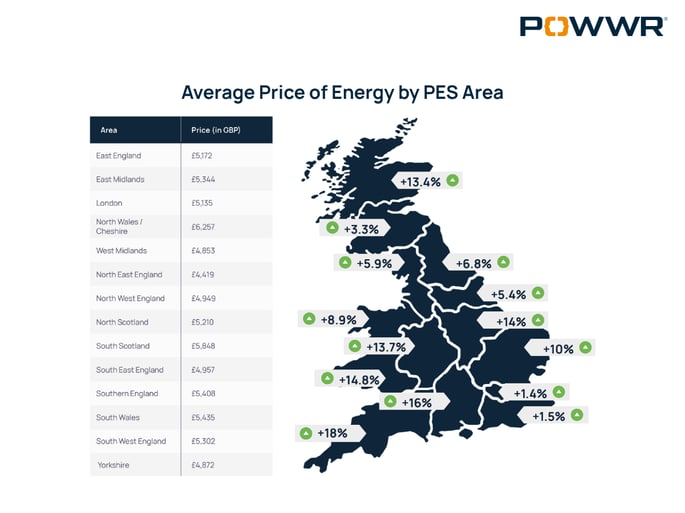
The data makes clear that no region is escaping price pressures - but the pace of increase varies considerably.
Energy Consumption Is Also on the Rise
It's not just prices that are climbing - usage is too. Average energy consumption has risen by 1,500 KWh (7.1%) quarter-on-quarter, bringing the average UK business to almost 23 MWh per year.
Part of this is likely weather-related: the British Isles experienced particularly difficult conditions in early 2026, driving up heating and operational energy demand. All business sizes have seen consumption increase, but very large businesses (those using over 100 MWh per year) recorded the biggest jump.
Highest consumption by region:
- South Scotland: 25,492 KWh (highest in the UK)
- North Wales: 24,631 KWh
- Southern England: 24,565 KWh
Lowest consumption by region:
- North East England: 19,267 KWh
- North Scotland: 21,172 KWh
- West Midlands: 21,407 KWh
Notably, only London and South East England saw their energy usage fall this quarter, every other region recorded an increase, with South West England (+15.5%) and Southern England (+14.9%) leading the way.
Contracts Are Getting Shorter - a Sign of Nervousness?
One of the more telling behavioural shifts this quarter is in contract lengths. The average energy contract UK businesses are committing to has dropped from 28 to 27 months - a modest but meaningful indicator of reduced confidence in the market.
The trend is most noticeable among larger organisations. Very large businesses reduced their average contract length from 28 months to 26 months this quarter, indicating a reluctance to lock into long-term agreements while prices and market conditions remain uncertain.
Across the 14 PES regions, nine saw average contract lengths decrease. The sole exception was London, where businesses actually committed to slightly longer contracts this quarter.
This cautious approach is understandable - but businesses need to balance flexibility with the risk of being caught without a contract at all.
The Switching Opportunity: Don't Leave Money on the Table
Amid all this pressure, there is good news: shopping around still pays off.
POWWR's data shows UK businesses could save an average of 2.7% on their energy bills simply by switching suppliers rather than rolling over onto a renewal contract. For some business sizes, the savings are even more compelling:
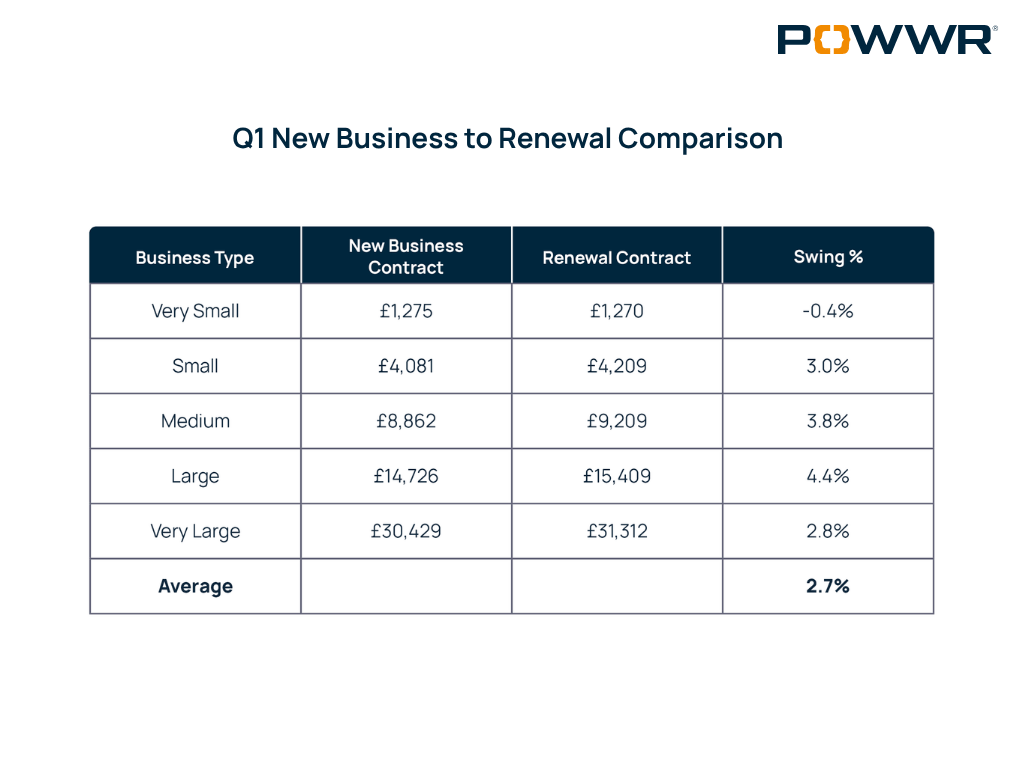
Large businesses stand to gain the most - a 4.4% saving equates to £683 per year, purely by switching rather than renewing. In an environment where bills are already rising, that's a meaningful number.
What This Means for Brokers and Suppliers?
For energy brokers, this data is a powerful conversation-starter. Businesses across every segment and every region are under pressure, and many won't yet be aware that their renewal contract is costing them more than a new deal would.
The data also underlines the importance of timing. With contract lengths shrinking and businesses increasingly wary of long-term commitments, the window to engage customers and present compelling new options is narrowing. Brokers who can act quickly, with accurate pricing data and a compelling proposition, will have the edge.
For suppliers, the combination of rising prices and shorter contracts signals a market under strain. Retaining customers through renewal pricing that better reflects market rates, rather than defaulting to standard renewal uplifts, will be key to avoiding churn in the months ahead.
Looking Ahead
The latest POWWR Energy Barometer Report paints a challenging but nuanced picture. Bills are rising. Usage is up. Businesses are nervous. But there are also real, actionable savings available for those willing to shop around.
In the meantime, the message is clear: businesses at or near the end of their contracts should be actively reviewing their options now. Waiting could mean rolling onto a renewal contract and paying hundreds of pounds more than necessary.
Want to See What This Data Means for Your Business?
Ready to see the full picture? Download the Q1 2026 POWWR Energy Barometer Report for the complete data - regional breakdowns, contract trends, consumption figures and more.
POWWR provides the tools and data energy suppliers and brokers need to win more business, price more accurately, and serve their customers better.
Or get in touch with our team directly: hello@powwr.com
Share this

Can Discovering Energy Market Secrets Empower Your Retail Business?

Energy Predictions for 2026: What’s Next for the UK Market